
Showing posts with label tropical plants. Show all posts
Showing posts with label tropical plants. Show all posts
Wednesday, August 29, 2012
tropical Hibiscus

Friday, December 9, 2011
Tropical Tree/Shrub ID: Bauhinia
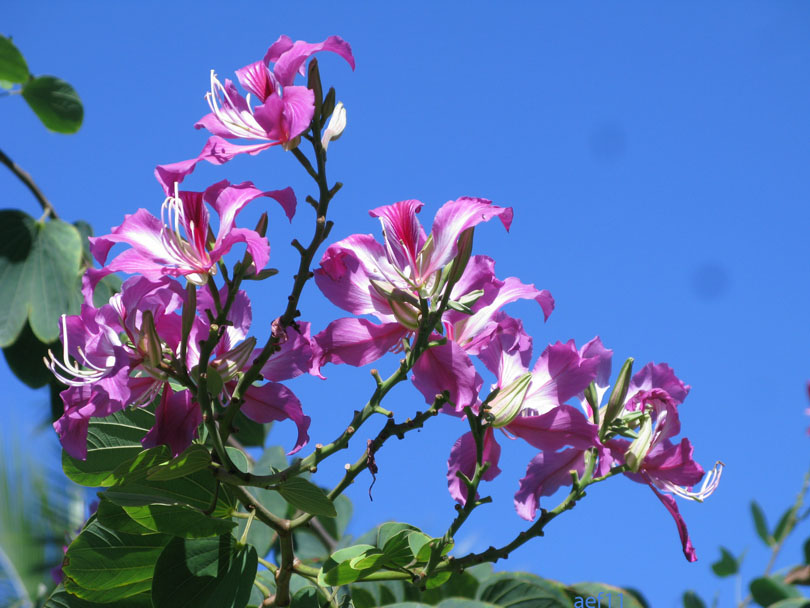 My first time coming across Bauhinia, a tropical tree growing outside of where we were staying in St. Lucia. The fragrance of this guy, commonly called an orchid tree, was so rich and pungent in the evening air it would stop you dead in your tracks. Thanks to Charles Y. for helping me ID this one.
Thursday, September 1, 2011
this year's water lilies in the secret garden
 love the sky reflection in this shot
 Tropical water lilies are in the aquatic plant genus Nymphaea, photographed here in all her macro glory. To learn more and see previous years pics click on the Aquatic Plants tag at the bottom of this post.
 This years hybrids have flower spikes that sit well above the water, moreso than the ones grown in the pool over the last few years I've been around. I'm not sure the exact name of these cultivars but so fun to think about all the options out there thanks to those clever plant breeders. The lilies will last into the fall until the water and temps begin to really dip so get up there and check them out if you can.
Saturday, October 31, 2009
Aquatic plants: tropical water lilies
 As many of you out there in gardenland know, now is the time to get those tender tropical plants indoors for the winter. One of the great tropical plants in my summer routine which I have been meaning to write about are water lilies. Water lilies are known botanically as Nymphaea, and are found really all over the world: Australia to Asia, Africa, here in North America, and on and on.
 These kinds of aquatic plants have roots that grow in soil under the water, and have to be anchored in and fertilized through the summer months when they are most active. Usually the soil is a dense clay and you top your containers with pebbles or stones, being sure to avoid covering the crown of the plant.
 There are hardy species of water lilies out there that can go as cold as a Zone 3, but most of the ones you find at retailers are the tropical species and hybrids. For your all your plant buying be sure to make an effort to know the plant's cold hardiness. The USDA created a hardiness zone map that can be the most helpful when learning about plants and horticulture and especially when experimenting with tropicals in our temperate climate. It can help to show you the natural range for a plant, which then can help you figure out how to provide it with the best environment to thrive in your garden. To see what the USDA hardiness zone map looks like, and to bookmark it for yourself for the future, click here. Obviously with climate change and global warming zones are shifting and exceptions are present, but it is still an invaluable guideline as a gardener.
 Most tropical Nymphaea are hardy to zones 11-12 which means they would be happily growing all the way down in southern Mexico. Tropical water lilies like a summer water temp between 65-70 degrees Fahrenheit (at least!), and in order to over-winter want a winter water temp around 50 degrees. They really need exposure to full sun in order to do well, and placid water is a must. Potting and placing aquatic plants in a water feature can be really fun and easy and provide a great twist to your summer. Of course if I had/when I have a yard big enough to have a pond I would like to experiment with both the hardy species and the intriguing might-blooming tropical Nymphaea that are out there.
 And mind you, these are not lotus, which are aquatic plants in the genus Nelumbo. Some people seem to confuse the two but they are really very different plants. Water lilies grow their foliage (lily pads) on the water's surface where lotus leaves sit above the water. The same goes for the flowers, with lilies much closer to the water's surface if not on it, and lotus flowers are much more upright. This is a lotus up at the New York Botanical Garden from back when I was a student in 2005.
 Anyway, I'm babbling.
 This is a tropical day-blooming hybrid water lily. They are on their way out now, and didn't get as much sun as last year, but still strike me as being so beautiful.
Sunday, March 2, 2008
Amazing Seed Germination

(A cluster of flowers from a tropical shrub I believe belongs to the Jatropha genus, Florida, January, 2008)
Over the last month and a half I have been propagating some seeds that I collected down in
Most people understand that seeds grow into plants, but I realize now that many people don’t understand the specifics of exactly how that happens. In the office I’ve been using these Jatropha seedlings to explain that very process, and I thought a short blog entry might be enjoyable for others to learn from.
So, let’s first revisit the steps. I gathered the seeds once they had been fully formed and dropped by the plant. Different seeds require different methods of being sown so that the seed coat properly breaks and the plant has the best chance of successful germination, but I knew that these were quite easy. I followed
I placed the soaked seeds on top of moist soil in plastic containers, to retain moisture longer compared to clay pots, and covered the whole thing with plastic wrap to create a mini greenhouse. Then I waited to see what would happen.
Not even a week later I peaked under the plastic wrap to find that the seed coats had been cracked. A tiny growth had emerged out of the seed and right away began to dig down into the soil. This is called the radicle. The radicle is the initial growth out of the seed that will help the future seedling to get nutrients from the soil and establish roots for the plant. In order for the seedling to take and the plant to do well, it has to first have roots to anchor it and provide nutrients in order for stems and leaves to follow. By about two weeks later I pulled the seeds from their plastic pots to see if roots were developing. I was thrilled to see a number of healthy white roots so I transplanted the seedlings into a slightly larger container, the clay pot you see photographed above. I kept them under plastic wrap to keep the humidity levels high and watched them daily to make sure they didn't dry out. What you can see in the photographs above and below is the next step, a growth called the plumule. This is essentially the initial stem of the plant, from where leaves and other stems will emerge over time.

 Jump to another two weeks later, now mid-Febraury, and you can see how quickly the plumule has developed into the initial stem of the seedling. Because this plant is considered a dicot, a certain kind of angiosperm, or flowering plant, it produces two leaves right away.
 Now the seedling has established roots, stems, and finally leaves, and can photosynthesize and create energy to continue to grow on its own. It becomes less reliant on the energy stored in the seed, because the seed has already done it's part and gotten the process underway. This seedling actually held on to its seed for a long time and I was kind of surprised. When I thought the seed must have finally been empty and couldn't give any more, I was amazed that it was still pushing out new growth in the form of a long stem and many little leaves. Eventually I knew that the plant would become self sufficient enough that the seed would soon fall off the plant.
 By the 22nd of February, you can see how the seedling has grown and become a new plant of its own. The seeds themselves had finally fallen off and were just laying on the soil surface. Today, March 2nd, I even found the roots growing out of the bottom of the pot so it is clearly time to repot the seedlings into larger containers. Since Jatropha multifida can grow to be a woody shrub well over 6' tall and wide I'm curious to see how much it will grow during the upcoming spring and summer!
Sunday, January 27, 2008
Garden Photography from the American Orchid Society
While on vacation down in Florida the week before last I visited the American Orchid Society visitor center and botanical garden in Delray, FL. Their outdoor gardens are filled with a large selection of plant material: trees, shrubs, herbaceous plants, palms of all sizes, and of course orchids everywhere. These photographs are of plants other than members of the orchid family that I discovered in the gardens that day. Enjoy.
 Barleria oenotheroides is commonly called yellow barleria and belongs to the family Acanthaceae.

 Solandra longiflora is commonly called golden chalice or chalice vine and belongs in the nightshade family, Solanaceae. This species is native to the West Indies, has more of a climbing habit, and grows in USDA Zones 10-12.
 Stropanthus gratus is commonly called climbing oleander or India rubber vine and belongs to the dogbane family, Apocynaceae. Native to tropical western Africa, this semi-climbing shrub does well in Zones 10-12.
 This is the flower cluster of a certain Begonia that I was not able to identify to species or cultivar. It was a shrub form with these fabulous pink clusters of blossoms. I was able to tell it was a begonia because of the distinctive leaf shape and imperfect flowers, which are either male or female.
 This flower spike emerged out of the center of a plant with long, narrow, leathery leaves with spines along their edges. Even though I was not about to identify it to species and/or cultivar, I am pretty certain that given the fluting habit of the plant and the flower spike it is a member of the bromeliad family, Bromeliaceae.
 Bambusa vulgaris 'Vittata' is commonly called golden or yellow-stemmed bamboo and belongs to the grass family, Poaceae.
 This is a kind of Heliconia, a group of about 100 species of tropical evergreen perennials belonging to the banana family, Musaceae. Even though identifying Heliconia to species can be tricky, the small flowers backed by those brightly colored bracts can allow you to identify to genus with some ease.
 You might be able to tell by the foliage and placement of the flower spike that this Portea alatisepala is another member of the Bromeliaceae family. Native to Brazil each of those purple buds will open to a narrow tubular flower.
 Lastly there were a lot of tropical ginger in bloom, this one a red ginger, Alpinia purpurata. The ginger family is botanically referred to as the Zingiberaceae. Native to Melanasia, the upright red flower inflorescence stood just about 6' or 7' feet tall and over time might grow to 10' or 12' tall.
(please note that all the above photography is the property of Alex Feleppa and is not to be copied or duplicated without written consent, thank you. -AEF)
Subscribe to:
Posts (Atom)