 Finally the white flowering crabapples in the Conservatory Garden are blooming their heads off.
 I had a few minutes to get these shots this morning and as I'm sitting here editing I can still smell their sweet, ever-so-subtle fragrance.
 Love spring.
 Finally the white flowering crabapples in the Conservatory Garden are blooming their heads off.I had a few minutes to get these shots this morning and as I'm sitting here editing I can still smell their sweet, ever-so-subtle fragrance.Love spring.
 The crabapples in the Conservatory Garden in Central Park burst out on Monday. The heat has moved the flowers along quickly but they were still looking (and smelling!) stunning today. This week I've taken well over 100 pics so it is going to be a little while before I get them all up. The main point is, if you live near Central Park and haven't treated yourself to a walk recently, you should! This couple below was loving life. She was crashed in the sun and loving it, and he didn't look too miserable himself. As I said to the two guys I was chatting with at the end of the work day, "how can you go wrong with 20,000 tulips?" More pics from "the office" to come soon. ...and as always click to enlarge.
 cheers,
 It's that magical time of year again. The crabapple allees in the Conservatory Garden are officially in bloom.
 Malus floribunda is the botanical name for Japanese flowering crabapples.
 As the stories goes, the 44 trees that make up the two parallel plantings that flank the central, Italian section of the Conservatory Garden were raised on a farm up in Newburgh, New York. Supposedly the trees were brought down the Hudson on a barge while in full flower either the spring of 1936 or 1937 on their way to be planted in the garden which opened to the public in September of 1937. What a sight that must have been, even if these trees were much smaller those decades ago. Half the trees, those adjacent to the lawn, set pink buds but have white flowers and the other half are a very strong pink from beginning to end.
 The pink ones come out just a day or two before the white. They explode late April and if the temperature stays nice and steadily cool then the flowers can last for a few weeks. If it gets really hot they shed their flowers quickly. The tiny flower petals of pink and white rain down on you as you stroll through the serene tunnel of statuesque, mature trees. It is in fact a magical time if you can catch it.
 This morning I found, following much anticipation, the Japanese flowering crabapples (Malus floribunda) of the Conservatory Garden beginning to bloom. Because of their color and bloom time everyone sees them and thinks they are flowering cherry trees. Like cherries (and pears and hawthorns and...) crabapples are members of the rose family so it makes sense that the flowers fool people. As with all plant ID you have to learn to see more than just one thing, like flower. Especially with woody plants you have bark, stems, buds, leaf, flower, fruit/seed. If you want to really get good in the garden you have to expand your abilities of observation. Once you get to know the bark of cherries versus crabapples it gets easy to differentiate.
  An allee (with an accent over the first "e", pronounced "Al-aye") is a landscape design term for a parallel planting. In the Conservatory Garden in Central Park the Japanese flowering crabapple allees date back to the 1930's and divide the three sections of the formal garden. Here you can kind of see the difference in the pinks, right? The trees closer to you with the lighter pink color are actually only in bud. They will actually open white as I will show you in the next couple posts. The trees behind are that fabulous vibrant pink that is such a wonderful surprise for the senses this time of year.
 This Japanese flowering crabapple tree is one of the largest, if not the largest of it's species in Central Park. Planted during the original installation of the Conservatory Garden which opened in 1937, this beautiful specimen is at least 75 years old, if not a few years older. ...and clearly fabulous in every season.
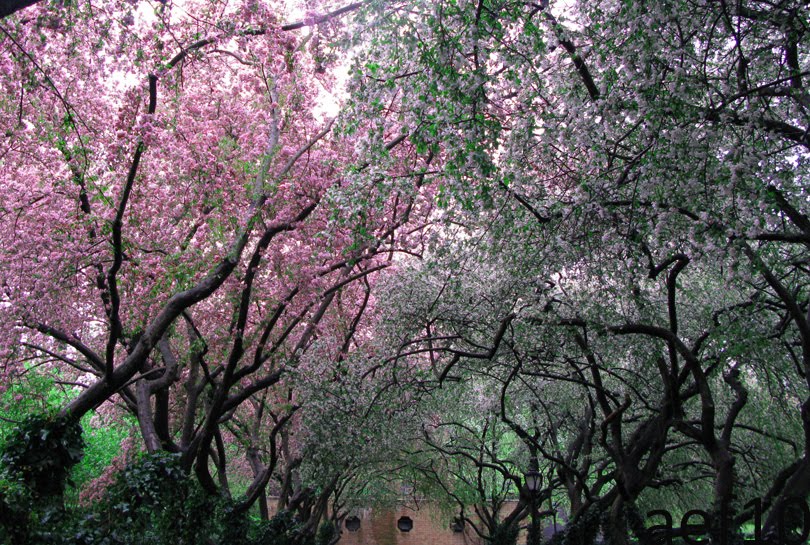
 The north allee of Japanese crabapples (Malus floribunda) at the Conservatory Garden in Central Park.
 Though one side of the allee buds pink the flowers are actually bright white, even during a morning rain.
 In the south allee you can see the other side of the allees better, the true pink crabapples, also botanically known as Malus floribunda. These trees were grown on a farm up the Hudson and brought down on a barge in full flower one spring before being installed here before the garden opened to the public in September of 1937.
 And then in the south garden (English Garden) there is also a purple leaf sand cherry (Prunus x cistena) just coming into bloom. This fabulous small tree gets to about 10 feet with a slightly narrower spread and then begins slowing down. The spring flowers are tiny and precious and then the tree maintains it's red leaf color through the season. This time of year everyone who comes through the garden confuses the crabapples and cherries, which is understandable since they are both members of the Rose family.
