Showing posts with label gardening. Show all posts

Saturday, August 20, 2011

the fennel and the "fat cats"

In 2006 I worked up at Garden in the Woods, the native plant botanical garden and headquarters of the New England Wild Flower Society. While up there I met Erin Backus, entomologist and horticultural therapist from upstate New York, and we became quick friends. We had a fabulous time interning with the Horticulture Department adding our abilities and able hands to the garden. While I worked on various woody plant renovation and restoration projects Erin was busy fostering the populations of native moths and butterflies. With great signage and information accompanying her netted displays of different caterpillars feeding and metamorphosizing throughout the garden you quickly fell in love with these "fat cats" as she liked to call them. It was such fabulous work because it is very important for people who want to have beautiful butterfly gardens to know that you have to have both the flowers that the mature butterflies love, but also the plants that the larvae caterpillars need to feed on in order to grow and develop. Sometimes they are woody trees or shrubs, or sometimes much more tender perennials. Most larvae, especially moths and butterflies in the order Lepidoptera, are very specific as to what "host plant" or plants they feed on.
Enter the fennel and the fat cats I found today in the Conservatory Garden in Central Park.


Fennel we love for it's use as a vegetable and herb, with both culinary and medicinal uses. Botanically fennel is known as Foeniculum vulgare, a member of the family Apiaceae. Originally from the Mediterranean region of Europe fennel has now naturalized throughout North America. Hardy in Zones 5-10 Foeniculum has strong hollow stems and fine, wispy foliage upon which form these fun umbels (an inflorescence of flowers that makes a flat-top) of yellow flowers in summer. (I shot these in midday sun so you can't see the fine, soft foliage so well, sorry.)


Florence fennel is grown for it's big bulbous base, but there are also other, narrower varieties of fennel known as 'bronze' fennel, and this is the latter. It doesn't produce that fat base, at least not so far as I have seen, but it does produce the same aromatic stems and foliage that smell of anise. The plant provides a wonderfully soft backdrop and shot of yellow to the other more bold, showy annual plants that Curator Diane Schaub loves to play with in her yearly displays.
And in this case we learn that fennel is a great host plant if you want to have the eastern black swallowtail butterfly in your garden.
This is the late instar caterpillar, the larvae of a stunning native butterfly called the eastern black swallowtail, Papilio polyxenes. The day I captured these guys in the garden I saw some tiger swallowtails but no black swallowtails so I am still searching for a photo for you for reference. For now here is the wikipedia link.

Sunday, August 14, 2011

Carver, the Manhattan Land Trust, and Farming Concrete

The other evening I got to visit one of my favorite spots in Harlem, a community garden named Carver. Carver is a wonderfully quiet and unassuming little oasis tucked just a block away from the main metropolitan vein of 125th Street. From the blocks of retail monsters, street vendors, and masses running from one gritty location to another you can turn and find a simple chicken wire fence and look in to see raised planter beds and in the back a covered gazebo.

Carver is one of the 14 community gardens in Manhattan maintained by the Manhattan Land Trust. The Manhattan Land Trust is a nonprofit organization established by gardeners to support and sustain community gardening throughout Manhattan. Our collective mission is to preserve, improve, and promote community managed open spaces for the benefit of all. As a member on their Board of Directors we have been working hard over the last number of years to transfer the ownership of these gardens to the gardeners themselves, and in such a way that these locals can ensure for themselves and their future generations the preservation of these vital green spaces in New York City. Victorious, as the gardens deeds were formally transferred from the city to the MLT in June of this year, it's been a great year for the MLT and our gardeners.

This evening there was an operations meeting. I arrived before the other board members and garden representatives from around the borough to find the gate unlocked and a man busy working in the gazebo. I walked up and reintroduced myself to a staple of the garden, a quick-witted and kind man named Jimmy. Jimmy was doing a little canning of his favorite veggie concoction which included a little bit of everything harvested from his plot here in the garden. Luckily he hadn't yet added the vinegar so he let me have a taste. Laced with a hot pepper or two he warned me it had some heat to it, and ooh wee, was he right! But so good, just the right mix to get you through the cold winter months to come.

Before the meeting got started I poked around a bit and checked out what people were growing. Here are a few shots from Carver.

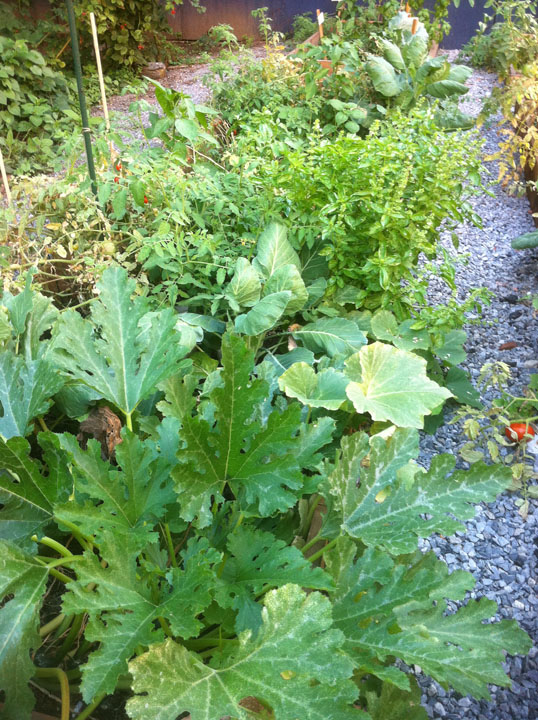
The cantaloupe was still small and green but the different squash were taking shape and ripening up beautifully.
Look at that perfect butternut squash hiding under that big, wonderfully textured leaf, and the zucchini below, nearly the size of Erica's arm!

This evening was sensational for a couple reasons. Of course it was very inspiring, as my trips to the MLT gardens always are. Determined to maintain community and health and well-being in the face of this urban jungle and all it's seemingly backwards development I love, admire, and value these gardeners and their gardens more and more with each passing season.

The second reason for my elation this particular evening was due to the fact that Erica Packard, dear friend and Executive Director of MLT, was introducing us all to another genius nonprofit called Farming Concrete. Ray Figueroa joined our little circle and explained his organization, which works with community gardens all over the city to properly document the amount of food produced in these different open spaces. As he so eloquently put it, "...because we're not just planting food, we're planting social responsibility". With an extremely smart and systematic approach Farming Concrete helps New York City gardeners by giving them the scales and forms to easily document all that is grown in their gardens, from greens in spring to veggies in summer, to fruit and nuts in the fall. Banning together and producing this Crop Census city-wide we can show to the folks in City Hall and up in Albany exactly how much good we are growing in these unassuming little lots. As Ray reminded us this evening a healthy diet is the best preventative medicine in the world. Thanks to Farming Concrete and their plan we can show with precision the numbers, the solid proof of the work being done and the successes within different communities, some of which are quite needy of course. Not to mention by showing the pounds per square foot produced, or pounds per square acre, we can then show the potential of other gardens and open spaces and why it is essential that we continue to find ways to return to the earth instead of cover it over with blacktop. Last year calculating the quantity grown in New York City and it's estimated value Farming Concrete showed that a million dollars of food was grown by local communities for local communities throughout the five boroughs. Isn't that amazing?!? I might even imagine it was even more than that, but to have a million dollars of food clearly documented that is quite a feat.

Wouldn't it be so fabulous to have that number continue to increase year after year as urban gardeners continue to ban together and organize for a greater good? Oh, you know it!

Friday, June 10, 2011

Recycling in the garden

I saw this today and thought it was brilliant. The quick explanation is that someone used their cut bulb foliage as mulch for their freshly planted veggie garden. Knowing how recycling your cuttings can give back to your soil and your plants essential nutrients that they need to strive through these hot summer months, priceless.

the longer train of thought goes like this:

Often I don't think your average gardener is educated enough about recycling in the garden. When we cut and remove green foliage from the garden because we are tired of it we have to remember that the garden can still use that "garbage". When you study professional turf management (a bit of a tangent, I know...) you learn the real value of Nitrogen, the macro-nutrient that plants need to survive that keeps their foliage green and plush. Everyone wants a rich green lawn that looks and feels fabulous, let's face it, it's a great thing to have. So you do the right thing and in the spring you over-seed if necessary and apply the right fertilizer with 25% water soluble Nitrogen for the quick shot and 75% water insoluble Nitrogen which is going to slowly breakdown and give your turf a nice steady feed through the summer months. Maybe you spoon feed your lawn a bit around July 4th, but ultimately you are set until the fall and can go on about the rest of the yard. You get into your summer mowing schedule and if you are most people you pick up and remove the grass clippings. But have you ever thought about the nutrients you are removing in the form of those rich green clippings? What most people don't know is that grass cuttings can be left on a lawn and refeed those thousands and thousands of plants with an unbelievable amount of nutrients. Yes, over time you have to then learn about the "thatch" that dense turf creates and you will have to incorporate aerating your lawn into your spring protocol, but you can maintain a much more self-sustaining and healthy lawn in the long run. You'll be psyched and your neighbors will wonder how you do it.

So take that thought and revisit the cut bulb foliage used as mulch. Yes, ideally you want to leave bulb foliage attached to the plant for as long as you can stand it after the flower is past until the foliage is totally yellow and no longer photosynthesizing. However, let's face it, you look at your daffodil and tulips leaves for so long and they begin to look pretty tired and your patience is gone, it's time for them to go. It's time to make way for the other perennials emerging. But if those cut leaves are still green then they still have valuable amounts of Nitrogen and other nutrients that can be recycled back into the soil. The only thing that I would change is that I would try and grow a lot more bulbs so I had even more foliage to lay as mulch, which would allow for really making a great look out of the long strands. You could lay a lot down and give the mulch a greater sense of movement and design. Weeks later I would see that the woman also used cut iris foliage, which is big and flat and gray-green and beautiful and she had enough of that to lay out a great looking pattern below the brightly colored swiss chard at the other end of her genius mini veggie garden. I love being impressed by the things people come up with in the garden when you think a little bit and go with your own creativity. Makes me wish I came up with the idea! You're mulching which is one of the best things you can do in summer because you are regulating the soil temp, keeping moisture in, and helping to keep the weeds suppressed. Not to mention you are recycling valuable nutrients and making your soil better so you can grow whatever you want to try. And you're not spending anything more than time in your awesome garden, making the earth that little bit more green. Like I said, priceless.

Saturday, October 31, 2009

One Tough Betty

As we all know, this time of year the focus switches to fall color, that sensational last show taking over the northeast before we close down for the winter. But I have to interject here to show off a rose that is one tough cookie. I admit roses are not as special to me as they are to many people, but when one is so reliable and relatively so easy it obviously deserves attention.

Lynden Miller is a internationally known public garden designer and I am lucky to say a good friend. A week ago or so she was giving a presentation of her new book, Parks, Plants, and People: Beautifying the Urban Landscape at the Museum of the City of New York. She has transformed so many urban landscapes into precious and appreciated parts of our lives, necessary parts of our lives, and her guts and determination are brilliantly inspiring. She was showing pictures of gardens she has overseen the rescue and renovation of, including the Conservatory Garden in Central Park, certainly one of my most favorite spots in Manhattan. Lynden shared images of the garden when she began her work with the Central Park Conservancy in the early 1980's. Many of the flower beds were overgrown with weeds and you couldn't make sense of the original design, or even what was left of it. The images showed the neglect and decline over the years. And then amazingly enough, one photograph of the Burnett Fountain showed these roses. Rosa 'Betty Prior' is a modern floribunda rose, and amidst the messy green hodge-podge they lit up the bleak landscape with their perky pink single blossoms. Today the same roses are easily 30 years old or so and with regular pruning in the spring and deadheading through the summer they keep producing these amazing carmine-pink flowers until frost. That's what I call one tough Betty!


Keep in full sun in rich soil with clean surroundings and prune back hard to 10"-18" in spring. As always prune your roses above the nodes with 45-degree angled cuts so that emerging buds are all facing outward from the center of the plant. Prune anything less than pencil thickness and focus on getting as much sun into the central crown of the plant for best growth and flower.