When the flowers pass it begins to leaf-out with the three-part leaves from which it gets it's specific epithet, trifoliata. Ultimately it's a gnarly, thorny thing that requires a lot of maintenance to be kept really picture perfect but just the same I love it.
Tuesday, July 31, 2012
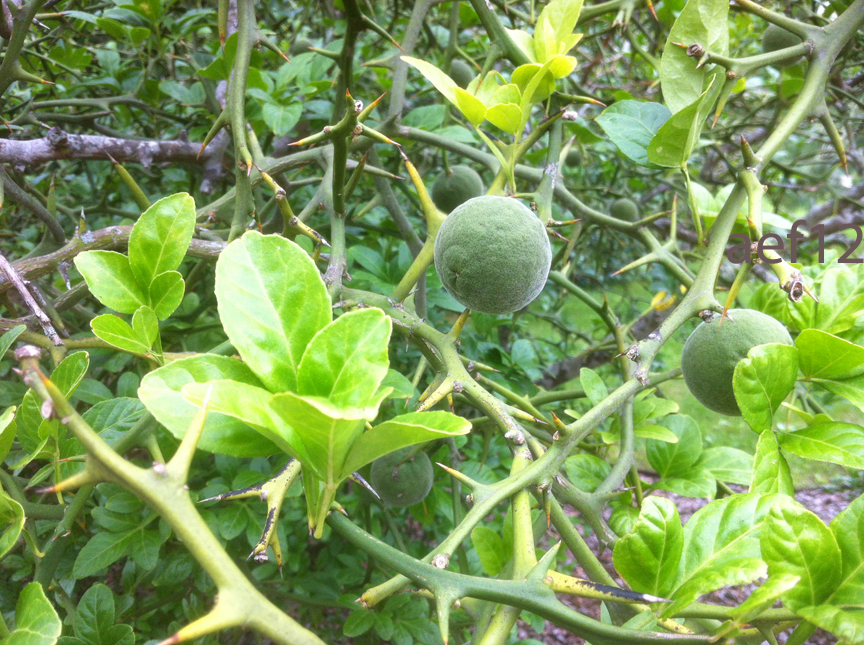
Tree of the Week: Hardy Orange (Poncirus trifoliata)
When the flowers pass it begins to leaf-out with the three-part leaves from which it gets it's specific epithet, trifoliata. Ultimately it's a gnarly, thorny thing that requires a lot of maintenance to be kept really picture perfect but just the same I love it.
Monday, July 4, 2011
Shrub ID: Rhododendron maximum (rosebay rhododendron)
I'm pretty sure this is Rhododendron maximum, the North American native rosebay rhododendron.
A broad-leaved evergreen, the rosebay rhodie is a big open shrub that can get 15' for sure, if not 30' over the course of it's lifetime for us down here in a Zone 6b or 7a. These guys are hardy to USDA Zone 3, which means well into Canada, where the species is apparently from. They usually bloom earlier, in June, but perhaps this guy was a new planting and therefore blooming a bit later. In any event, big fabulous clusters of white flowers are tinged with pink and yellow.
This guy is obviously just a youngster, weighing in at only 6-7' high and wide, but you can see the open habit and love for high shade or a little bit of sun through the canopy.
Shrub ID: Sambucus canadensis (American elderberry)
This is a beautiful native shrub (from Canada, introduced in 1761) I saw on a walk through the woods the other day. It's name is Sambucus canadensis, or American elderberry. You can see the bees love the flower, and in the fall the dark purple fruit attract the birds. The fruit is high in Vitamin C and popular for pies, jelly, juices, and wines. The shrub grows 8'-12' high and wide according to most, but because of it's more unkempt growth habit you want it to have some space.
These awesome flower clusters are called cymes, which basically means they are a group of tiny, solitary flowers that form a flat-topped blossom, in this case slightly domed. The picture below is a bit blurry but you can see better the pinnately compound leaves that make up the body of the shrub. Each grouping of 7 leaflets you count is actually considered a single leaf. Botanists identify leaves by finding their buds. Each leaf has a bud at it's base, so if the leaf is destroyed the plant can make a new leaf from that same node on the stem. I don't have a close-up, but if I photographed the main, central stem in the photo below you would see that the leaf buds are there in the center, at the base of the leaf stalks (petioles) going left and right, and at the base of the leaflets there is nothing but the petiolule, or leaflet stalk, sans bud. Hence we can say that it is a compound leaf, comprised of 7 leaflets.
Again, not the greatest shots but a valuable woodland shrub for Zone 4-9.
Saturday, April 16, 2011
Shrub of the Week: Spiraea thunbergii
It's been a truly sensational year for the Spiraea thunbergii. That's right, a kind of spirea. When I tell people it's a kind of spirea most people follow with, "oh, bridalwreath". As I often have to correct, this is not bridalwreath spirea (Spiraea prunifolia) but a different species known commonly as a Thunberg spirea, or as I prefer, Spiraea thunbergii. There are something like 70 spirea species out there which I myself had little to no idea. I've become fond of this Chinese native, having learned about it via the Conservatory Garden in Central Park where it's used as one of the many different hedges throughout the nearly 6-acre formal garden.
Left to their own devices (and not hedged) these shrubs would not be very different in size, but would certainly have a more rounded, upright habit with tons of the fine stems and branches arching outward. A member of the rose family, this sun lover has tons of tiny little buds all up and down their slender stems that explode this time of year, and what a year indeed.
I can't say I've ever seen these bloom so exquisitely in the few short years I've known them. The individual white flowers are smaller than your pinky nail, but with thousands and thousands of them you obviously can't go wrong. And the best parts have yet to come. This summer these guys will give way to a vibrant brighter green foliage that plays wonderfully off the slender stems of reddish brown, the leaves thin and lanceolate to further provide great fine texture to the landscape. I then love when they drop their leaves in fall and you are left with nothing but the killer cinnamon reddish wood, which literally seems to glow in the evening winter sky when placed with rich green conifers. I'm telling you, a shrub worth knowing. From my mentors I am told it is more of an old fashioned shrub and not so common in the trade but I admit I'm out of the loop on this one. It's been a while since I was a nursery plant slinger.
Spiraea thunbergii- native to China
- hardy in Zones 4-9
- typically grows to 3-5' feet tall and easily as wide
- white spring bloomer
- member of the rose family, Rosaceae
- needs full sun and halfway decent soil
Wednesday, March 30, 2011
In Bloom: Cornus mas
The Cornus mas (Cornelian cherry, a member of the dogwood family) are beginning to bloom, ...very psyched.for cultural info visit this post from late March, 2009.
Sunday, March 13, 2011
Plant of the Week: black pussy willow
I've worked in close proximity to this plant for years but not until this spring did I realize the subtle fabulousness of the black pussy willow. These photographs were taken late February, and you can see above the black catkins just emerging from their protective winter shells.
Salix gracilistyla 'Melanostachys', or Salix melanostachys as some refer to it, is a sunny, water-loving shrub that doesn't get to much more than 6-10'. In the landscape I have found it to have a low, spreading habit that looks attractive incorporated into a slope or woodland setting. The species is introduced from Asia and is a healthy grower, but I think it is pretty easy to keep in bounds with regular pruning. As you can see above it doesn't instantly draw your eye to it this time of year but once you get a bit closer you realize what you are looking at.
A sturdy filler in the landscape for sure, the real draw of course is it's unusual late winter gift of these fuzzy black pussy willows. What we call pussy willows are the catkins of shrubs in the Salix or willow family, Salicaceae. A catkin is an inflorescence of flowers, meaning many many flowers grouped together to appear like a single entity. Yet it is pretty fair to say that catkins don't look much like flowers at all since they are much more utilitarian and lack showy petals which most people associate with flowers. Instead what you have are a bunch of "apetalous" flowers that bunched together look like this.
In the case of Salix gracilistyla 'Melanostachys', these male catkins emerge and remain as these fun black pussy willows for a period of a few weeks. Then as all pussy willows do, they change form. If you have ever brought pussy willows into your home to put in a vase or arrangement you were probably originally surprised that they didn't remain those cute little fuzzy treats. That's because most pussy willows are cut and sold before the flowers fully develop.
Here you see what the black pussy willow looks like once the male flowers have opened exposing their yellow pollen-tipped stamens. This was forced inside my office for the purposes of the blog and supposedly the ones still outside opening up will have a little more of a red hint to go along with the yellow. Either way I think they are great looking and quite unique.
Thanks to Dirr's "Manual of Woody Landscape Plants" (Fifth Edition) and "Flora: A Gardener's Encyclopedia" for factoid confirmation
Saturday, February 19, 2011
Bees!
On a woodland slope in Central Park one of my favorite late winter bloomers is once again coming to life. Hamamelis vernalis is commonly called winter witchhazel, a fabulous medium-sized native shrub and the latest of the North American Hamamelis species to bloom. Every year I seem to take the same shots of these first shrubs and bulbs to throw some color into the late winter landscape. And so as I was approaching my reliable friend for the "hort porn" macro shots I thought to myself, "how can I change it up this year and make these more interesting". Not that the shrub and it's unique spidery flowers aren't amazing in their own right, but you might know what I'm talking about. Well, luckily for me nature stepped in and decided to rock my world. Bees!
As I sniffed the medicinal fragrance that I have come to love about this plant I heard the buzzing. Pulling back I realized the witchhazel was loaded with bees doing their wild dance among the clusters of yellow and maroon flowers. The first bee sighting of the year my focus quickly shifted to these magnificent little pollinators. A few great shots came from the series. Remember, the more native species you incorporate into your garden the more you also support and provide for local bird and insect populations, all good things.
Enjoy, and Happy Almost Spring!

I think this one might take the cake:
For more info on Hamamelis visit last years post here.
Friday, March 26, 2010
Plant Pic of the Day
Wednesday, March 24, 2010
Garden Pics of the Day: Corylopsis
Corylopsis pauciflora! (aka buttercup winterhazel)
The flowers are really more chartreuse but I still like how these came out. A great woodland shrub.
Corylopsis pauciflora--commonly called buttercup winterhazel
--native to Japan and Taiwan, introduced in 1862
--hardy in USDA Zones 6-8
--dainty 4-6' shrub with equal or larger spread
--fragrant flower inflorescences in early spring
--interesting leaf and texture in summer
--great yellow fall color in late October
--place in full sun in high pH soil with plenty of organics
--to ensure best bloom large fragile buds must be protected from wind and late winter storms
Talk about spring, right!?!?
Tuesday, March 16, 2010
Hamamelis vernalis: the last days of winter
The Hamamelis vernalis (vernal witchhazel) and Galanthus (snowdrops) have been in flower for a little while now. Thanks to the return of the sunlight little clumps of Crocus have opened to show off their bright yellow stamens amidst delicate cups of white edged in lavender. I cleaned up the ratty leaves of the Helleborus (Hellebores, Lenten Rose) and their blooms are opening rich purple, brilliant white, and green throughout the woodland slope. At last the Iris reticulata are bursting forth, their perfectly proportioned miniature bodies appearing through the debris only a few inches tall. The first shots of color in the late winter landscape are reminding us of the magical season to come. The Narcissus (daffodils) are pushing their foliage, like the little Muscari (grape hyacinth) in front of them. The Tulipa will take more time, but still the green tips of spring life are exhilarating.
Hamamelis vernalis:--commonly called vernal Witchhazel
--member of the Hamamelidaceae family
--Grows to 6-10' high and greater in spread
--Hardy in USDA Hardiness Zones 4-8
--Medium growth rate
--When in leaf provides nice medium texture to a landscape
--Durable woodland plant but is not a big fan of being transplanted once established

Thanks to Michael Dirr's Manual of Woody Landscape Plants: Their Identification, Ornamental Characteristics, Culture, Propagation and Uses for factoid conformation. And if you are at all serious about woody plants and/or landscaping, this is a book you must own. -aef
Monday, October 26, 2009
Now that's what I call color
Aesculus parviflora is also known as a bottlebrush buckeye

Stewartia pseudocamellia is also known as a Japanese Stewartia

And here is a little Lagerstroemia indica, the common crapemyrtle, the cultivar 'Tuskegee'
Thursday, June 4, 2009
adaptation, species, and time

Just because we see beautiful plants and forms in the natural landscape, like these Juniperus on the eastern end of Long Island, does not necessarily mean that the same species are going to look like that when nursery grown or planted in your landscape. The following is a little email back and forth about how plants adapt to varied environments and the different forms a single species can take. I thought you might be able to get something out of it. Enjoy:
Alex,
a professional question -- I would like to plant a "MONTAUK" shadbush in my garden- twisty gnarly branches. I see them all over, but I can't find the botanical name and the guy who does our garden brought me two straight-branched Serviceberries…. I know SHADs are supposed to be Amelanchier (s) but no photograph I've seen on line shows twisted stems or branches. Are they a unique sub-genus or a mutation - maybe a type of Amelanchier nantuketensis? I know NOTHING about this...help me please, I'm going nuts...
To which I repsonded:
Good questions. Within the genus Amelanchier there are a couple different species and it can get confusing because each species has a number of different common names. Amelanchier arborea is commonly called downy serviceberry, shadbush or servicetree. Amelanchier canadensis is commonly called a shadblow serviceberry or thicket serviceberry. As the botanical names would suggest the arborea has a growth habit that is more of a tree form while the canadensis is more of a suckering shrub. There are other kinds of Amelanchier of course. I am sorry to say I do not know Amelanchier nantuketensis though.
Whatever the landscaper brought could have been the plant you want. The difference is that he is bringing you nursery grown stock and it will never look like the weather-contorted forms you see around the neighborhood. Those natural shrubs grew from tiny seedlings and only after years and years of beating have they become the amazing forms they are. Nursery stock is given the right amount of sun and water so they will always be much more perfect than what you want.
So basically you have two options. Plant nursery grown stock young and know that it is going to take a while but will get there. But it will take time. It will probably take a bit of a beating just getting acclimated, and that will take a few years, but then the new growth will be more stunted and interesting depending on the exposure to the elements. When ever I am teaching people plant selection I am always reminding them that a plant acclimated to your landscape is going to look quite different than the way it looked when you bought it. Plants grow, change, and adapt to live most efficiently in different situations. A nursery grown plant might be a few feet tall after only a couple years, but the contorted shrubs around which might not be much taller than a few feet themselves could easily be over 20-30 years old easy. A naturalistic form of bonsai if you will. The other option is to see if any of the big nurseries ever get "specimen" pieces of Amelanchier. Marders would get odd-ball specimen pieces they would buy off of locals looking to re-landscape. Of course the trick there is that a one-of-a-kind piece like that could cost hundreds or thousands of dollars.
I would say buy young and let it acclimate and see what form it takes. Spending big money on a more mature specimen that might not acclimate as well is not worth it. The forms they will take might not be as contorted as the ones more exposed on the streets and bluffs but then down the road you can have me over to give you a pruning lesson.
Then CB replied:
Hi, thank you... wow...the trees they brought were VERY tall (10 feet plus roots) so, as you said in your note, probably too late to adapt to the environment. A native plant retailer said there is something odd about the Montauk Shads - more than growing up in a windy environment, might be a sub-genus. That's why I thought this might be a good question for you.
Possibly the ones here could be Amelanchier nantuketensis, not canadensis -- as the name implies we are closer to Nantucket. But I will take your suggestion and buy one of his smaller bushes and watch what happens. He said construction jobs sometimes clear lots (I HATE SEEING THIS) and bring in specimens for him - so he might have one or two.
To make my garden guy happy, however, I might plant the big one somewhere, but I don't want it in my face every morning if it doesn't have that lovely undulation that is so unique.
I imagine that locals who 'get' Shads dig them up in the woods...not sure that's kosher. My neighbors' trees are quite old ("they were there when we moved in/built the house.")
Thank GOD I can talk to you about this! If I can find my camera I'll take a picture of the twisty montauk shads - there are NO pictures of them on the internet - and you can post them.
come see us next visit!
AF:
Cool, you know I had never heard of Amelanchier nantuketensis before now. I worked with a conservation organization a few years back but the focus was more on woodland plants. If you want to try and find a source for Amelanchier nantuketensis you can try emailing Katherine Powis, the librarian at The Horticultural Society of New York. She has some great plant and nursery source books to help find obscure plants. That species is classified as endangered in New York, threatened in Maine, and of special concern in Massachusetts which makes me fear you are not going to find it in the trade, but worth an ask I suppose. Katherine's email is kpowis@hsny.org and she is the nicest with funny requests like these. I would love to know more about native coastal plants myself. Obviously there is always so much to add to the repertoire. Right now I'm focusing a lot on color and formal perennial design, and trying to climb as much as I can in the off-time. But my love and I just got new surfboards so I am sure we will be out in your neck of the woods at least a few times this summer. And yes, speaking of woods, any poaching of plants from their natural habitat is absolutely terrible and it makes my blood boil, but if it is a property about to be plowed over then I admit I too would try and save whatever great plant material I could.
Wow, well 10' plus, then I would guess it to be Amelanchier arborea. According to Michael Dirr they can get to 25’ with variable spread. Without seeing it though I'm totally shooting in the dark. God knows I have seen 15' clumps of Amelanchier canadensis too. You can definitely plant and maintain more mature plant material, I don't want you to think you can't, but often it can require extra care and coddling to get established. The main thing with trees that big transplanted that you should know is that people never seem to water them enough. And especially out there were the soil is so sandy, it doesn't retain moisture the same way, so big trees like that need a good 2-hour soak at least a few times a week through the summer drought to get established. If you get a specimen/older piece then definitely invest in soaker hose, regular hose, and a battery powered timer. Its the smartest $100-$150 you will spend if you ever want to play with bigger changes to your landscape. You know, protecting your investments.
CB:
Thanks again for your advice. The big trees (one is still outside waiting to be picked up or planted...hmmm) that they brought were tagged Amelanchier canadensis. The slender branches are absolutely straight, though flexible and the tree seems to have been tapered, though it might be how it was trussed for shipping.
How's this for a theory: Montauk shads are unique - could they be a genetic variation, not just a response to the environment? I see twisty ones in sheltered places all over Montauk, but driving west, they did not have that kinkiness. (Well, you know Montauk...everyone's a little screwy here...) Anyway, when I find my camera (or buy a new one...) I'll send you an image.
AF:
Probably environmental adaptation over genetic variation but they are both aspects of natural selection and therefore totally possible. It just goes to show species and their incredulous determination to live on. Genetic crosses and mutations do happen, creating dwarf hybrids and things like that, but I bet it is more the exposure and environment of a few basic species. Even in a sheltered spot we know how that wind and salt spray and sun out there can be nasty, moreso than the protected streets further inland. Ah Montauk, yes, as they say, ...the end!
The conversation went on and CB told me about the Grimes family out in Montauk, who own Fort Pond Native Plants. She had amazing conversations about the species the different generations have seen in the wild and the potential hybrids or sub-species that have arisen over years of natural selection brought on by the challenging environment, disease issues like Cedar-Apple Rust, human development, and so much more. For many years I have been meaning to check out Fort Pond Native Plants out in Montauk because I hear they do a great job. Obviously we are very much on the same page so now I really have to make a point of getting out there.
Wednesday, May 27, 2009
peony panels


Paeonia sp.
Conservatory Garden
late May, 2009
There is so much in bloom right now out in the gardens. Us horticulturists are doing all we can just to keep up. Hands are extra dry, back is feeling it. Most plants are in, but much in holding we got to get in the ground. You know the routine. It's spring, it's summer, the momentum accelerates. We get busy. And in this case I don't have the same time to devote to all the garden photography and plant records that I wish I could get lost in. I don't have the time to share with you all the amazing forms and flowers and textures I am lucky enough to call my "office". It's a shame really. But alas, it's getting late by my early bird standards, hell, it's past my bedtime, and tomorrow is no break from the norm.
In bloom in NYC:
Paeonia (peony)
Rosa (rose)
Baptisia
Iris
Geranium
Salvia
Clematis
Nepeta
Kolkwitzia (beauty bush)
Weigelia
...and so much more.
still holding on:
Allium (ornamental onion)
Nectaroscordum (formerly Allium) - a new plant for me this year. Love those tall nodding clusters.
Ok, have to crash. That's all for now. Be well. Get outside.


