Showing posts with label shrub ID. Show all posts

Tuesday, January 29, 2013

Shrub ID: Edgeworthia chrysantha (coming into bloom at BBG)

 I was in the city at the Brooklyn Botanic Garden for the annual horticulture trade show put on by the Metro Hort Group, Plant-o-Rama.  It is always a great event and one of the bonuses is checking in on this paperbush (Edgeworthia chrysantha) which comes into bloom about this time of year.
 As you can see it's a deciduous shrub.  Most references list it as being hardy in USDA Zones 8-10 which would mean it wouldn't survive the winters here in New York, but as you can see, situated in the right protected spot with good sun and well-drained soil it can do quite well up here.  Below is the flower starting to emerge.  Many people know the wonderful winter interest of different native and non-native species of Hamamelis (witchhazel), not to mention Camellia japonica (Japanese camellia), but you definitely want to know about Edgeworthia as well.  The flowers will open to reveal short, fragrant, tubular flowers yellow to creamy white as we get into late winter.
 
 Edgeworthia chrysantha:
- commonly called paperbush
- native to China
- member of the daphne family, Thymelaeaceae
- grow in rich soil with ample water and sun to part-shade
- leaves are elongated, oval, mid-green
- can grow to 6' high and wide
- the genus is named after Michael Pakenham Edgeworth (1812-1881), botanist, plant collector and employee of the East India Company
(Flora: A Gardener's Encyclopedia, 2003, Timber Press)

Monday, August 6, 2012

Flower ID: St. John's Wort

Hypericum x 'Hidcote'
Hidcote St. John's Wort
small mounding deciduous shrub to 4'
full sun to part shade
tolerant of dry soil
prune late winter

Tuesday, July 31, 2012

Tree of the Week: Hardy Orange (Poncirus trifoliata)

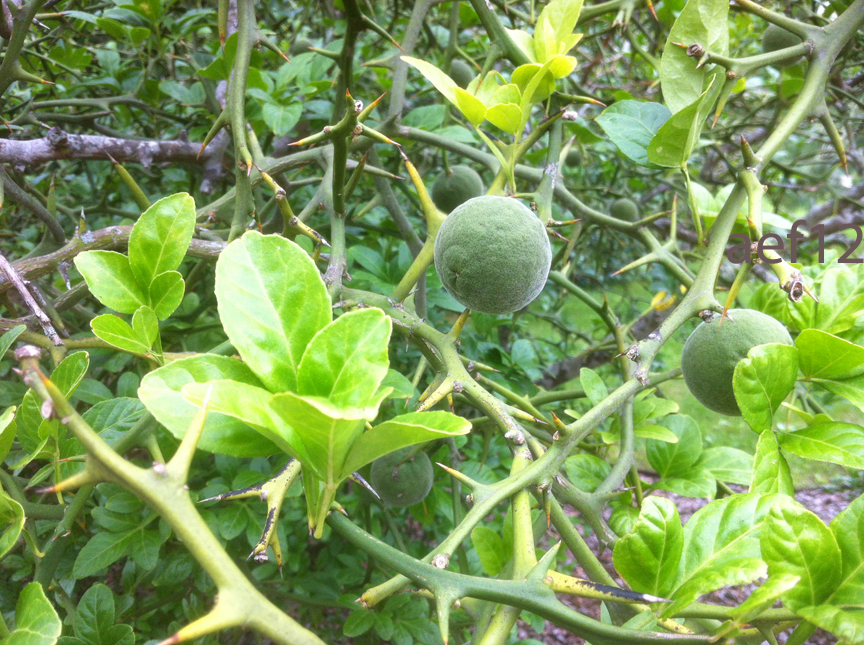
 Poncirus trifoliata is commonly known in the Northeast as hardy orange or bitter orange.  It's a member of the family Rutaceae, like all of it's other citrus and citrus-like relatives.  This is a shot taken now, as the fruit begin to form.  You can see the formidable thorns that hardy orange are known for.

It's a big oval creature, whether you consider it a shrub or tree is up to you.  They tend to grow 10-20' tall and often two-thirds as wide.  On the eastern end of Long Island they bloom late April.  As you can see the white five-petaled flowers are fantastic, and this year very prolific.

 When the flowers pass it begins to leaf-out with the three-part leaves from which it gets it's specific epithet, trifoliata.  Ultimately it's a gnarly, thorny thing that requires a lot of maintenance to be kept really picture perfect but just the same I love it. 
The thorns and hardy acidic fruit make it a fun conversation piece here in our Zone 6b or 7a.  It's safely hardy in Zones 6-9.  Native to China and Korea it was introduced to the US around 1850.  
 It's one of those rare trees that are fun to observe in every season.  The spring flower is sweet and wonderful.  The stems of green and serious thorns mix in well with the summer landscape while still giving it plenty of character.  Not to mention the great fuzzy fruit that begin to form.  By fall they will mature yellow, loaded with lots of seeds and very, very sour.  According to Dirr if you let the fruit set for a few weeks it develops a nice acidity, as well as the peel worthy of being candied, but can't say I have ventured that far with my love of this small tree.  Perhaps I will experiment with a few of these fruits this fall.