Showing posts with label trees. Show all posts

Tuesday, July 31, 2012

Tree of the Week: Hardy Orange (Poncirus trifoliata)

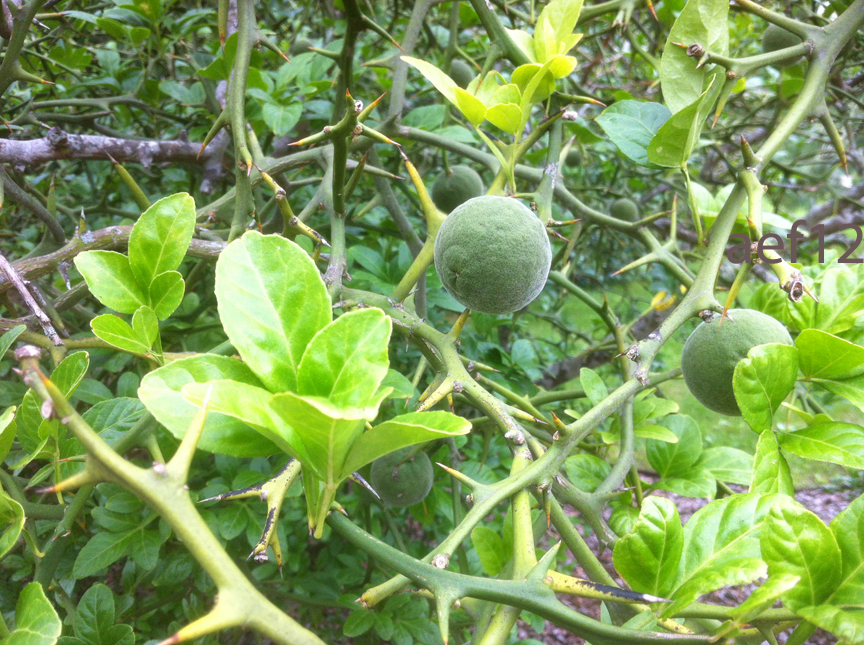
 Poncirus trifoliata is commonly known in the Northeast as hardy orange or bitter orange.  It's a member of the family Rutaceae, like all of it's other citrus and citrus-like relatives.  This is a shot taken now, as the fruit begin to form.  You can see the formidable thorns that hardy orange are known for.

It's a big oval creature, whether you consider it a shrub or tree is up to you.  They tend to grow 10-20' tall and often two-thirds as wide.  On the eastern end of Long Island they bloom late April.  As you can see the white five-petaled flowers are fantastic, and this year very prolific.

 When the flowers pass it begins to leaf-out with the three-part leaves from which it gets it's specific epithet, trifoliata.  Ultimately it's a gnarly, thorny thing that requires a lot of maintenance to be kept really picture perfect but just the same I love it. 
The thorns and hardy acidic fruit make it a fun conversation piece here in our Zone 6b or 7a.  It's safely hardy in Zones 6-9.  Native to China and Korea it was introduced to the US around 1850.  
 It's one of those rare trees that are fun to observe in every season.  The spring flower is sweet and wonderful.  The stems of green and serious thorns mix in well with the summer landscape while still giving it plenty of character.  Not to mention the great fuzzy fruit that begin to form.  By fall they will mature yellow, loaded with lots of seeds and very, very sour.  According to Dirr if you let the fruit set for a few weeks it develops a nice acidity, as well as the peel worthy of being candied, but can't say I have ventured that far with my love of this small tree.  Perhaps I will experiment with a few of these fruits this fall.


Monday, June 4, 2012

the great American Elm, revisited

 Recently I got a great email from an arborist up in Maine.  Earlier in the year, Michael would tell me, he was down in my neck of the woods helping with a tree survey conducted every few years for the USDA to scout for the Asian Longhorned Beetle.  Sure enough I totally remember those men and women as they were in the north end of Central Park which was my "office" and climbing trees I had longed to climb for years.  Michael and two other arborists would get to climb this magnificent American elm and so I wanted to show him all three shots I took that day back in March.
Michael, the one I posted before is this first one, slightly cropped, just FYI.  Let me know.
Best,
Alex


Friday, May 18, 2012

beautiful branching...

This is a Styrax, a Japanese Snowbell, that was dug at the local tree farm and put on sale.  Full of buds this tree will soon be covered in tons of hanging little white flowers.  I really love the beautiful branching of this specimen, which will undoubtedly be a site to see in any season.

Thursday, March 8, 2012

Ulmus americana

Entering the park for my last day of work. That's a huge Ulmus americana, one of the last great American elms found in the north end of Central Park. This tree is one of the most beautiful specimens of American elm, and a joy to pass underneath every morning. Here we go folks, one last time...

Wednesday, March 7, 2012

the new Higan cherry on the Woodland Slope

Prunus subhirtella (in the center), commonly called a Higan cherry
Galanthus (underneath), commonly called snowdrops, one of the earliest bulbs
assorted others: Hydrangea quercifolia, Leucothoe, Spiraea thunbergii, Ilex crenata, etc.

crapemyrtle bowl

Lagerstroemia x indica (don't remember the cultivar, sorry)
Euonymus kiautschovicus 'Manhattan'
hedging shears (not pictured)

Conservatory Garden, Central Park

Tuesday, January 31, 2012

Crimean Linden, BBG

I always have a blast this time of year returning to Brooklyn Botanic Garden for another year of Plant-O-Rama, the Metro Hort tradeshow now in it's 16th year. It's a chance to reunite with old friends, connect with new ones, sit in on fabulous lectures and panel discussions, and enjoy celebrating the horticultural lives we lead. This year I was thrilled to finally get to see and listen to Michael Dirr, the national treasure as far as woody trees and shrubs. And even more we get to enjoy all of this over the course of a very fun, relaxed day on the grounds of a magnificent botanic garden. It's so good to visit with my colleagues who are now really the best of the best in my opinion, like Dennis Schrader from Landcraft Environments, Jim from Glover Perennials, and Erika Hanson from Anthropek Gardens, just to name a few. But it is a busy day of passing cards and networking so one of the best parts for me is taking a break from it all and being able to walk the grounds and revisit the trees I love, tended to by my BBG's sensational Arborists, Chris and Travis. Walking in with the morning sun this Crimean linden was really speaking to me so it became the shot of the day.

Wednesday, December 7, 2011

Friday, November 11, 2011

bark gallery

Betula lenta (sweet birch)

Quercus rubra (northern red oak)
a more mature Quercus rubra (above and below)

Ulmus americana (American elm)
Fagus grandifolia (American beech)
Quercus velutina (black oak)
Carya ovata (shagbark hickory)

Wednesday, November 9, 2011

Tree ID: Quercus palustris (pin oak)

If you want to start learning your oak trees this is a great one to start with. This is a young pin oak, Quercus palustris. On this foggy morning on the way to work I was elated to find this little guy because you can see one of the most interesting aspects of this particular species. Pin oaks have an attractive pyramidal habit in their youth and it's due to their unique branching. The lower limbs are pendulous, or weep slightly, the central limbs are horizontal, and the upper limbs point upwards toward the sky. Now you might think all trees limbs grow that way, as I did at one point in time, but as you reexamine your local trees you will see that this habit is really quite unique to pin oaks, and therefore makes them relatively easy to identify in the landscape. Most pin oaks planted in parks and yards can get limbed-up (the lower limbs pruned off to allow for easier passage underneath) so you eventually lose this quick indicator, perhaps another reason I was excited to find this specimen posing so perfectly this morning.

Tree ID: Acer rubrum (red maple)

Red maples, botanically known as Acer rubrum, are a great northeastern shade tree for many reasons. In spring before they leaf out (March into April) red maples produce great looking clusters of red flowers (click here for image of flowers). That in combination with the smooth gray bark was how I was able to identify the tree above when we moved across the street last winter. Our new neighbors talked about the amazing red fall color and just recently we got to see for ourselves.
These shots are of some red maple cultivars up at the new York Botanical Garden. You can see here the difference in the leaf. When people think of maples they tend to think of that quintessential 5-pointed or 5-lobed leaf silhouette. Here you can see that red maples, though they still have five lobes, tend to look more like a leaf with only three points. This can help you identify them in the summer when most maples are rich green in color and not so easy to tell apart. But then in fall of course we are further clued in as to why they are called red maples. As far as your standard list of maples often used in the northeast Norway maples (invasive bastards!) have a bright yellow fall color. Sugar maples can be every fall color imaginable but end up showing mostly oranges. But the red maples will always get this real intense red to scarlet coloration when they change in early November.

Younger trees have a smooth gray bark that helps you to identify them in the woodlands. They are also sometimes called swamp maples and as the name might suggest they do really well in a more wet situation. Often in a forest setting you will find them naturally living down closer to the stream edge or in lower, soggier areas. As the trees mature the bark transforms from being smooth to having these long vertical ridges and furrows, still a nice light gray. This mature specimen is located in the old growth forest up at NYBG.
There are of course a gazillion cultivars of red maples out there so you want to check your local nurseries and do your research before buying. I remember back when I was in the nursery trade we sold a lot of 'October Glory' and 'Red Sunset' but gosh, that was a good ten years ago.

Wednesday, November 2, 2011

pics from a morning stroll

I decided to take my camera along for my little walk and errand running this morning. Even though just a Hosta in this small cement urn I couldn't help but like the way the sun was hitting it from behind.
Everywhere in my neighborhood you see these small herbaceous plantings, such as these mums, peaking through the chain link fence in search of the sun. Get it, kids!
I could create a whole blog that was just old dilapidated laundromat signs from around the city. There is something about each sign and storefront that makes it unique, like the funny crooked ampersand.
People do some fabulous container gardening here in Astoria, land of the Greeks. Here they started with tall, narrow pots planted with red Mandevilla, a great flowering vine of an annual, and trained it up to create this whole elaborate trellis you walk under when coming or going. ...pretty fabulous.
Then I had to get stuck looking at all the new street trees. The Parks Department is about halfway through the planting efforts associated with their Million Trees NYC initiative which means over 500,000 trees have been planted in the last four years or less. As an arborist it's great because I never have to go far to find myself noticing new trees, eagerly trying to identify each one.
I am guessing that this new addition is a young black oak, Quercus velutina. Many oaks within the red oak family can look alike so often you have to carefully examine other parts of the tree in order to make your best educated guess. You need to look at things like the buds the trees set in fall that persist through winter.
In some cases you need to take into consideration the bark.
In both cases the buds and the bark seem closest to a black oak, though most of the black oaks I know are much older so there is some difference in their appearance. The reddish buds with their gray pubescence and gray bark with hints of a more yellow inner bark tend to make me think it is Quercus velutina over the other usual suspects like northern red oaks, pin oaks, and scarlet oaks. But again, just a guess for now.

Saturday, October 29, 2011

one path, four leaves

I've been feeling bad that I haven't been writing and posting more so this morning I figured I would use my phone to snap a few quick pics while on my morning walk setting up my work day. Here's a tiny installment of some of the fall foliage out there these days...
Sassafras albidum (common sassafras)
Called "the mitten tree" by my mother-in-law the leaves of this tree are variable, meaning they can take a few different shapes. Often you will see them like the one above with leaves that have one or two sinuses (the "dimples" or depressions in the leaf) and otherwise those large, rounded lobes. Sassafras love a wet location so you will find groves of them near waterbodies where they can still get some sun. They can be a great understory tree and advantageous colonizer when revitalizing woodland areas.

Quercus alba (white oak)
When beginning to learn species within the massive genus of oak trees, botanically known as Quercus, one of the first steps is learning the difference between the pointed, bristle-tipped oaks and the softer lobed oaks. The one above, with those pronounced lobes that are softer and smoother looking indicate that it is in the white oak group. In this case, I imagine this is a white oak, as they often have this fabulous deep red to maroon fall color. The other oaks, the ones with the more pointed bristle-tips are red oaks and their various relatives, and they too can have remarkable fall color. Most oaks take on a much more earthy bronze fall color but some like this white oak and the scarlet oak, a bristle-tipped oak named Quercus coccinea, show off these rich pigments of deeper reds and purples.

Liriodendron tulipifera (tulip tree)
Liriodendron, like all the others in this post, is a North American native and wonderful tree to find in the woods. Commonly called a tulip tree, Liriodendron produce a flower in spring that looks like a green, orange and yellow tulip blooming on the large angular branches that grow overhead. The tree itself can often be easily identified in the landscape because they can grow straight as an arrow and reach up to 100' comfortably. In the fall the color of the foliage is a rich, vibrant yellow. I tend to think that the leaf too seems to resemble a tulip's silhouette but I am not sure if that has any link to the common name.

Liquidambar styraciflua (sweetgum)
If you didn't know you might think this tree was some kind of maple with that five-pointed leaf and insane red fall color. But alas, it is it's own species, commonly known as a sweetgum. As far as stunning native trees I have always liked sweetgums, and when fall comes around you realize why they always make the various "top ten" fall foliage lists. The tree itself is not necessarily as tough as some of the oaks and maples out there but situated in the right spot they thrive and add great character to our woodland settings.

Tuesday, October 18, 2011

Notes from Around Town: Central Park's North Woods

This is one of the waterfalls in the ravine, a section of the North Woods of Central Park. Up in the central, north end of the Park is a section of woodlands that I find many people don't know about. And they definitely don't know that it is this beautiful, but they should, as should you. This spectacular bit of woods is right in Manhattan, smack dab in the middle of lower Harlem, and it's sensational. When Olmstead and Vaux designed the Greensward Plan which would ultimately become the blueprint for Central Park they wanted the North Woods to resemble a place both men loved, the Adirondacks. The result would be this 90-acre woodland of rolling topography and waterways, flowing choreography and stunning visuals of landmarks fused within nature. From bunkers dating to the War of 1812 to stands of towering tulip trees, from perfectly constructed stone archways to a wildflower meadow the North Woods is such a pleasant surprise for plant, wildlife, and landscape lovers in the city. One of these days I will take my good camera and take more shots for later, more lengthy posts. But yeah, you can get lost in the woods and love it, right in the heart of Manhattan Island.

Sunday, August 28, 2011

Wednesday, June 22, 2011

if you're a New Yorker, know this org

plant, preserve, protect

I recently completed a course to become a certified street tree pruner in New York City. And I admit it had been something I had been meaning to do for a while. In the five boroughs, in order for you to prune street trees legitimately you have to have approval from the Parks Department. So even though I know my trees and proper pruning techniques I had to jump through the proper hoops before I could go out and begin to beautify my local neighborhood. But I finally did, and can't tell you how happy I am to have done so. First of all I got to revisit and support a fabulous organization I have known for a while now. Second, I had to take a course, and as you know in horticulture and arboriculture you are never done learning. (PS, if you ever meet a gardener who says they know everything, be concerned, and definitely don't hire them to take liberties with your landscape!) Third, my conscience was starting to really bug me so it was time to shut it up and do the right thing.

Some years ago when I was Director of Horticulture for HSNY I was asked to be on the advisory council for the new Million Trees NYC initiative introduced by Mayor Bloomberg and Bette Midler's organization, New York Restoration Project. Via those myriad of meetings and discussions I was lucky enough to meet Susan Gooberman. Quickly I would learn that Susan was the Executive Director of a small organization called Trees NY, formerly the New York City Street Tree Consortium. An amazing cast of only 5 people, Trees NY has for years teamed up with the Parks Department to encourage, educate, and recruit New Yorkers to be stewards of the very trees that shade bustling city streets, help to combat the "heat island effect", remove pollutants from the air in exchange for vital oxygen, and vastly improve the quality of life in New York City. As I was those years ago, I was recently reminded of the huge and essential impact this tiny organization has on the city and its people.

I registered for the citizen tree pruner class a few months ago and signed up to attend the classes at the Arsenal in Central Park on 64th Street. (Trees NY now offers classes downtown, and in Brooklyn and Queens.) Based on my previous training I assumed most of the information would be more of a refresher, but as I said before you are never done learning so with an open mind I submitted my registration and gladly paid my $100 to Trees NY. The class would be held over over the next month and a half, with four 2-hour class sessions and one 4-hour jaunt out in the field to practice our pruning first-hand. Sam Bishop II is Director of Education for Trees NY and he did a fabulous job teaching our class. Like you might expect there were people from all backgrounds and all levels of knowledge and skill. In class we were all equals and quickly the information was fed to us in a smart and enjoyable fashion, and overall I think the class loved our time together talking trees. The time flew by and yes, even I learned a few things I didn't know before. It was so great. In the end I would pass the final exam to become a certified citizen tree pruner and aside from being elated that I finally supported Trees NY I was unexpectedly overwhelmed with such pride.

In short I can't speak highly enough about Trees NY. At our cute little graduation ceremony I would meet people from all boroughs excited to take on our new roles as NYC street tree stewards. I got to see Susan for the first time in years and we would have a ball reconnecting and talking about how the city is greener than ever. I ran into old friends from the Parks Department and learned that we are up to about 500,000 trees, so halfway in terms of the initiative. Before running off I would make Sam pose with me for a quick pic. If you are in the city and value the presence of green, know and support Trees NY. For only a handful of people they improve the quality of life for millions and millions of people, most of whom don't even realize it. If you want to go the step further, become a citizen tree pruner and help ensure continued success for these trees. In order for the Million Trees initiative to succeed and for us to create a healthier environment in this city we as citizens have to take ownership and get off our asses to help the cause. I assure you, the education, excitement, and sense of pride will make you feel real good inside, not to mention make this a better home for all.

Cheers,
arborboy
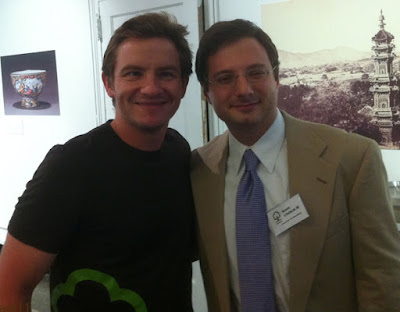
Me with Sam A. Bishop II, Director of Education for Trees NY